Could the Voynich manuscript preserve women’s knowledge?
I came to the Voynich manuscript through YouTube. What stayed with me was the way some women read its drawings of plants, baths and stars. I wanted to understand how they reached those readings and see how far AI could follow the evidence on the page.
Research direction and editorial investigation by Luana Micheau · AI-assisted analysis
In the fifteenth century, the physician Johannes Hartlieb urged writers to conceal recipes for contraception and abortion. Some of the people he wanted to keep from reading them were women. That history gives me a reason to take questions about secrecy seriously. What the Voynich manuscript’s own makers wanted to share, and with whom, remains an open question.
Lewis and Brewer read the Rosettes, a foldout of nine connected circles, alongside medieval medical accounts of sex and conception. They suggest its shapes depict what physicians of the period thought happened inside the body. They also document a dispute about access. The physician Johannes Hartlieb urged writers to conceal recipes for contraception and abortion, including from women who might use them. That gives the researchers a historical reason to ask whether a writer would disguise reproductive knowledge. Who wrote the Voynich and who could read it remain open questions. Read Lewis and Brewer’s research abstract
Could the baths and stars be a calendar?
Mossymatriarch
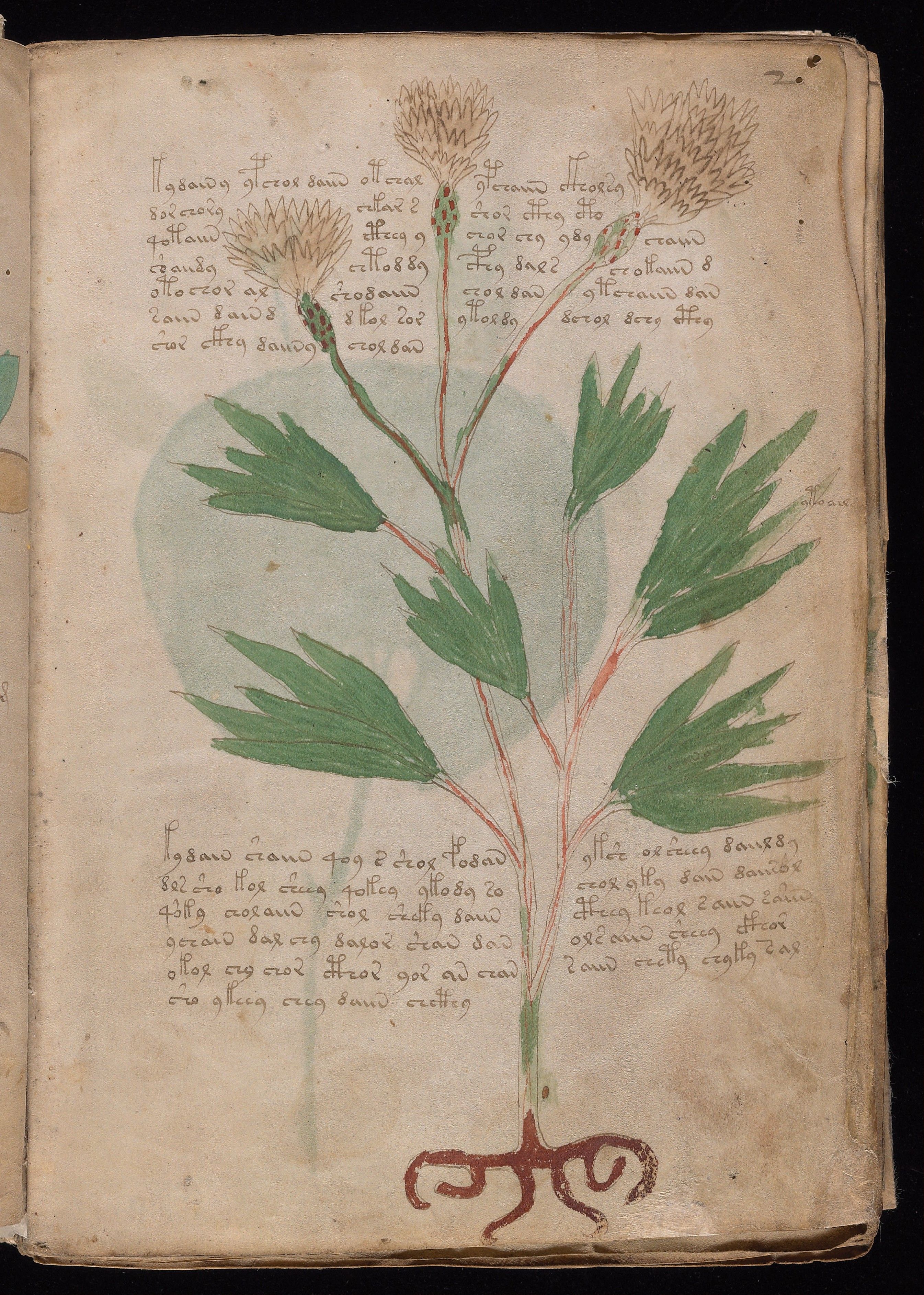
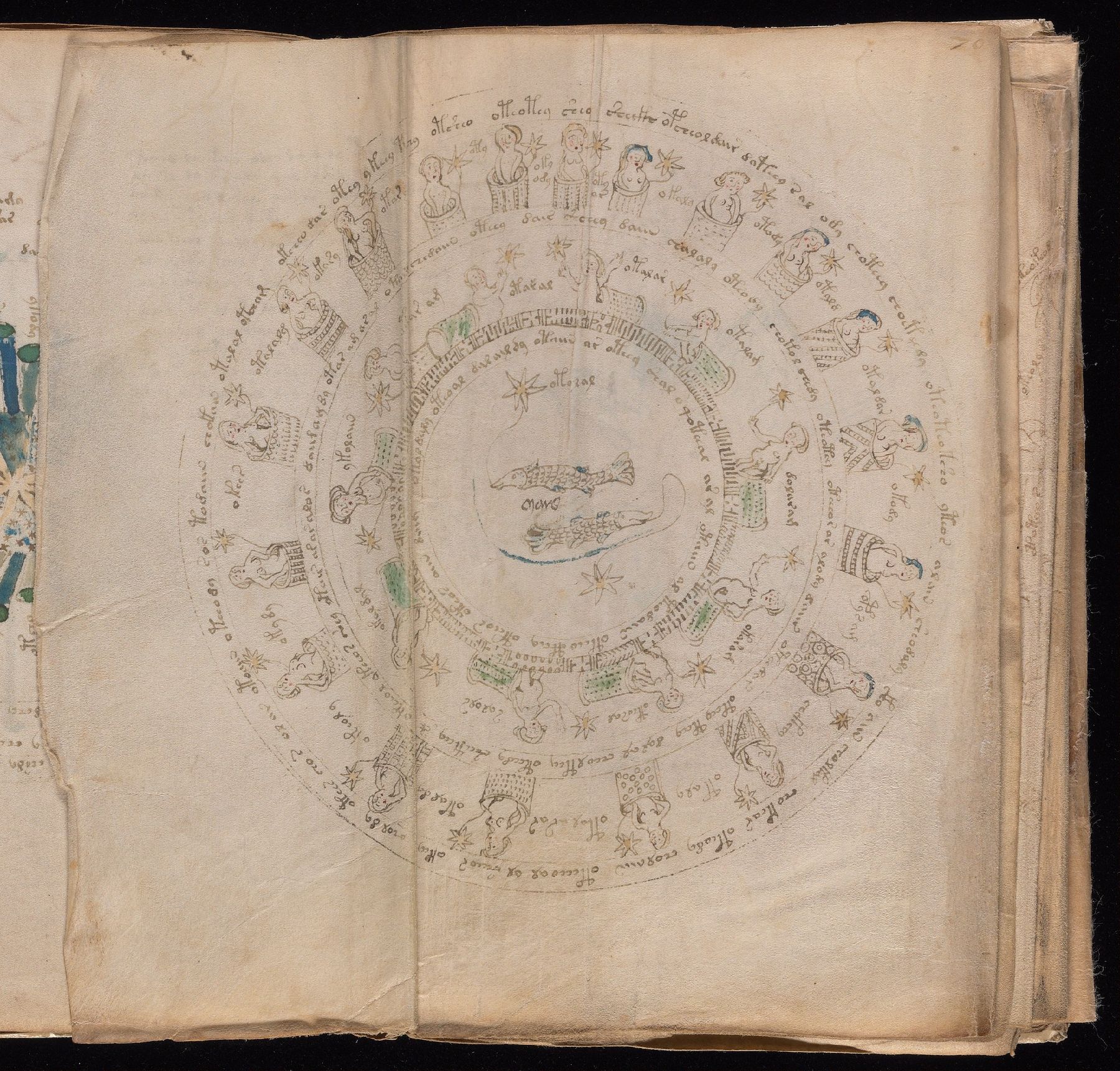
Mossymatriarch sees a connection between the red on some drawn roots, the figures in linked tubs and the stars beside women. She proposes that the figures mark times for bathing and planting, with menstruation and the movement of the heavens helping practitioners decide when to act. In her account, tending a body and tending the soil belong to the same practice. She imagines women making a book whose pictures another practitioner could recognise. She presents this as her own reading of the images. Read Mossymatriarch’s essay
What might the plant pages record?
TikTok creators, reported by Seneca Cabrera
Cabrera reports that some creators compared the manuscript’s unfamiliar plants with growth they associated with menstrual blood and “moon water,” their term for water left in moonlight. They suggest the pictures preserve knowledge women shared about fertility, ritual and growing plants. The argument begins with a visual resemblance. The project traced that claim to Cabrera’s reporting. The original video and the reported growing conditions were outside the study. Read Cabrera’s account of the creators’ claims
Could women have written the book for other women?
Lisa Fagin Davis
Manuscript scholar Lisa Fagin Davis leaves that possibility open. She watched the moon-water video and disputed how it interpreted the pictures. Her response makes room for two different questions. One concerns who made the manuscript and whom they hoped to reach. The other concerns whether a particular drawing identifies a liquid or records a practice. A woman could have made or used the book whatever that drawing eventually turns out to mean. Read Davis’s response to the video
The Pisces diagram on folio 70v. The two fish give us a clue to the subject. The surrounding words remain undeciphered. Beinecke MS 408, Yale University Library.
01 / The question
Could AI copy one line from the scan?
I started with the first line beside the plant on folio 2r. Using Yale’s scan and the EVA chart, which assigns Latin letters to glyph shapes, we recorded the AI’s six groups of letters before comparing them with the Takahashi and Zandbergen transcriptions. Three matched exactly. In two more, the AI had offered two alternatives, one of which matched. In the fifth group it wrote ytchaiin where both transcribers wrote ypchaiin. It also missed the place where the stem interrupts the line. Transcription sources
That check let me point to a particular stroke and ask whether the AI had copied it faithfully. Even a perfect copy would leave the meaning of the line open.
02 / Held-out folio evaluation
Could the writing predict the kind of illustration?
A Python program counted groups of glyphs in a published transcription. It learned which groups occurred more often in each of two illustrated sections, then guessed the section for pages from folios held out of training. We compared pages copied by the same hand and assigned to the same Currier category, a grouping based on patterns in the writing. Transcription dataset
0.8641
Herbal / pharmaceutical
Same scribal hand and Currier category. Different quires remain possible.
0.9500
Herbal / biological
Same scribal hand and Currier category. Different quires remain possible.
0.5000
Herbal / pharmaceutical
Same hand, Currier category and quire. Two folios per class.
Scores are balanced accuracy, the average recall across two classes. A value of 0.50 is chance by this measure. The same-quire check contains only two folios per class, so it does not prove that subject matter has no relationship to the text. It does show why the higher scores cannot be treated as decoded meaning.
03 / The method
Why did the score change?
A page's subject, position, layout and copying history can travel together. A classifier can recognise one of those signals and appear to recognise another. For the last comparison we used pages from a single quire, a bundle of folded sheets bound together. On that small sample the program scored at chance. The earlier scores may partly reflect where the pages sit in the book.
This builds on earlier research by Sterneck, Polish and Bowern, who found that text clusters track a combination of scribal hand and illustrated subject. Our contribution is a small reproducible example of why an exciting AI result needs a harder check.
What remains open
What would count as evidence for a reading?
The program had to choose a section label such as “herbal.” It was never asked to identify a plant, read a recipe or decide who wrote the book. Its scores leave the interpretations of menstruation and conception unresolved.
For a claim about a particular word, I’d want to record its proposed meaning before opening another folio, then check whether it makes sense there too. A claim about the pictures calls for different evidence, such as a dated medical diagram with labels we can read. The research Space records the method, code and individual predictions for the test we actually ran.